
Your Guide to Becoming a Certified Pest Control Technician
Published on November 20, 2025 by Nate Bortz
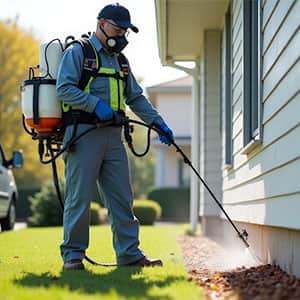
Pest control professionals serve their communities by protecting personal and commercial property from dangerous infestation. If you think of yourself as a self-sufficient problem solver who isn't squeamish, this may be an excellent career path for you.
Continue reading to learn more about prerequisite qualifications, licensing requirements, training programs, what to expect on the job, and different career paths.
Consider the Following: Job Requirements, Salary, and More
Before we dive too deeply into the application process, let's cover some basics.
Job Description
A pest control technician, commonly called an exterminator, is someone who uses various natural and chemical methods to remove unwanted pests from buildings and their surrounding areas. They also use their knowledge to educate customers on ways to help prevent further problems.
Common Duties
Technicians usually deal with issues related to pests like roaches, rodents, ants, and termites. The work often involves a lot of standing, kneeling, and performing duties in confined areas (such as a residential crawl space).
A typical day on the job will likely involve the following:
- Respond to calls and travel to customer locations
- Inspect buildings for signs of infestation (nests, damage, droppings) and find the source
- Determine the size of the infested area, create a treatment plan, discuss options with customers, and estimate service costs
- Safely use scenario-specific traps, bait, barriers, or chemical pesticides in a way that complies with all federal, state, and local laws
- Schedule additional treatments if needed, or recommend alternative long-term solutions
Average Pay
According to data from the U.S. Bureau of Labor Statistics, the average annual salary for exterminators is around $46,000.
Most are employed full-time and typically work for private companies or local governments. The five states with the highest average salaries (over $50,000) are Alaska, Colorado, New York, North Dakota, and Washington.
Education Requirements
A college degree is not required. Most employers only require a high school diploma and a driver's license. Once hired, new employees typically complete some on-the-job training.
One major requirement for most states is obtaining a pest control license. We'll cover more specifics, including education and exam information, later in this article.
Advancement Opportunities
Entry-level exterminators who gain enough experience and feel confident in their skills often apply for management positions. A few common options include branch or service manager, service supervisor, and route manager.
And if you have entrepreneurial aspirations, opening your own business could be a long-term goal.
How to Get Your License
Federal law states that anyone who applies or supervises the use of restricted use pesticides (RUPs) must be certified according to Environmental Protection Agency (EPA) regulations and state laws.
An RUP is a product that is not available to the general public and has the potential to negatively affect people and the environment if used incorrectly. That's why applicators must know how to use RUPs safely.
Technicians who work for a company are considered commercial applicators. The EPA's minimum requirements for certification in this category include passing two exams: one covering core pesticide safety and one for a specific category, or type, of application.
Pesticide Certification vs. License: Know the Difference
Certification uses testing to prove that an individual knows how to safely apply pesticides while minimizing risks to themselves, the public, and the environment.
A license verifies a person's legal standing to get paid to offer application services to the public.
Step 1: Determine State-Specific Requirements
The EPA acknowledges that regional licensing authorities may have additional or stricter certification requirements. The best place to find any unique requirements is your state's pesticide licensing authority.
These are just a few specific examples:
- Oregon requires a license to apply any pesticides to someone else's property, not just RUPs.
- In Massachusetts, applicators must hold a Core license (general use pesticides only) for at least two years before they can apply for Commercial Certification and apply RUPs.
- New Jersey commercial applicators cannot become certified until they complete a Basic Pesticide Training Course and complete 40 hours of on-the-job training related to their desired category.
- Florida applicants must have at least three years of experience as a service employee under a licensed applicator. Or, have a degree in entomology, botany, agronomy or horticulture from a recognized college or university, along with one year of experience under a licensee who works in the desired category.
Step 2: Submit an Application and Pay Required Fees
Many states use their own online application systems to simplify the process. Follow all instructions closely to ensure your application is approved.
Your state licensing agency should provide detailed instructions for scheduling your exams (in-person or online) after accepting your application and receiving payment for all applicable fees.
Step 3: Prepare for Your Exams
State governments are not required to provide study material for their licensing exams. Generally, the only study resources most states provide are lengthy, technical manuals based on local and federal laws. Luckily, better options are available that don't make you read through entire codebooks by yourself.
Our online exam prep courses are interactive study guides designed to help applicants pass their required exams on their first try. We collaborated with licensed pesticide applicators and code experts to develop accessible courses for the following categories:
- Core Standards
- Ornamental Plant Pest Management
- Turf Pest Management
- Aquatic Pests
- Field Crop Pest Management
- Lawn and Residential Landscape Pest Control
- Mosquito Control
- And More!
After passing your exams, the provider will share the results with your local regulatory board, which will then issue your license.
Maintaining Your Certification
Like most professional trades, pesticide certification doesn't last forever. An important part of the recertification process for most people involves earning continuing education units (CEUs). The number of required CEUs depends on your state and certification type.
Texas applicators are only required to earn a minimum of three CEUs per year, whereas some professionals in South Carolina need to earn as many as 20.
You can find your specific requirements, along with state-approved online course bundles and professional development options, by selecting your state in the Recertification dropdown menu.